

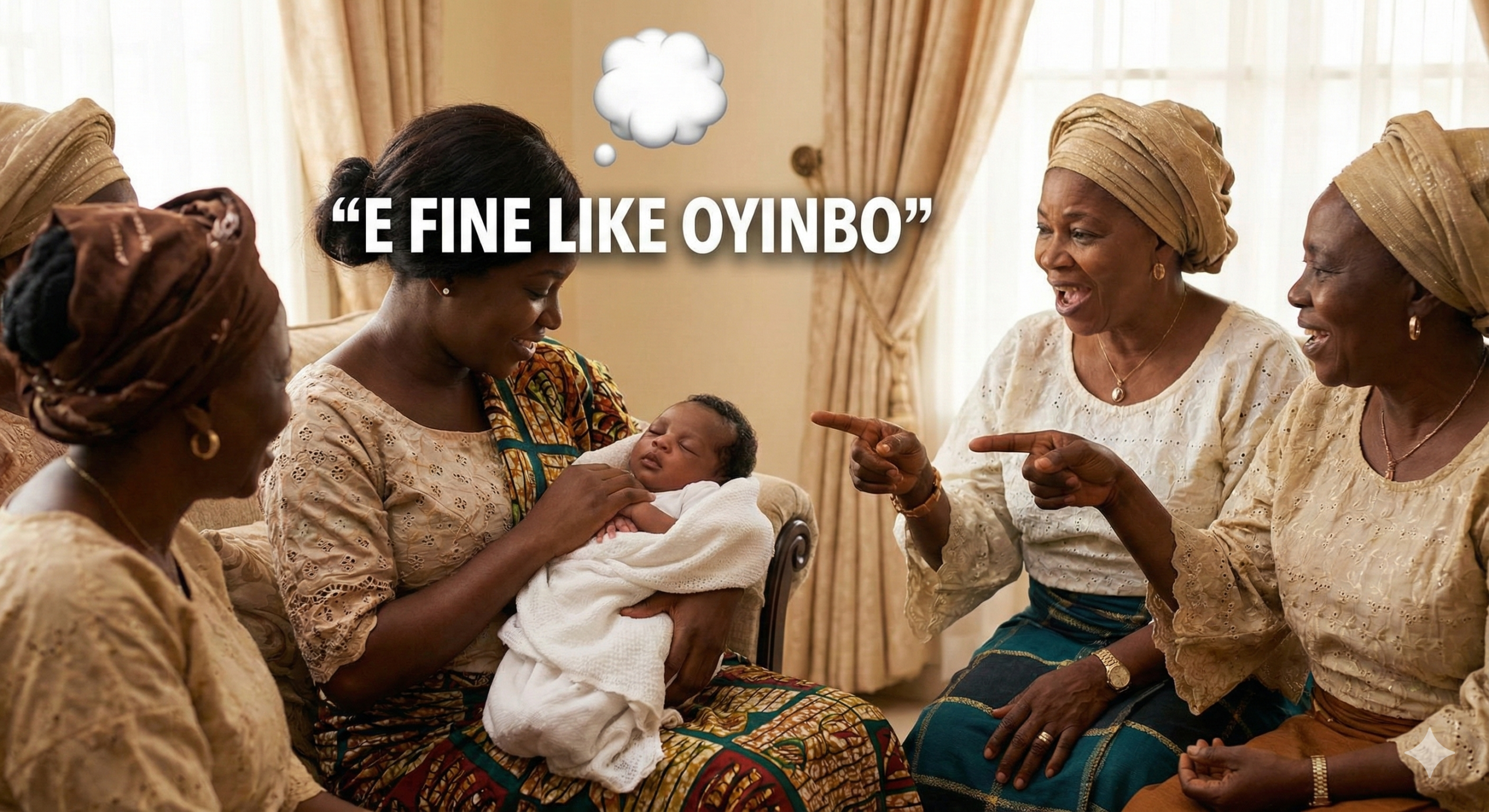

Recently, I found myself staring at a newborn baby in a Lagos living room. The child was barely a week old, swaddled in white blankets, doing that cute thing where babies scrunch up their faces while sleeping.
The room was filled with aunties and uncles cooing over the new arrival. Then, one auntie dropped the ultimate Nigerian compliment. She leaned in, clapped her hands together, and exclaimed, “Ah! See as the baby fine. E just fine like Oyinbo!”
Everyone nodded in agreement. “Yes o! Look at the hair. Look at the skin. Proper Oyinbo.”
I nodded along, because you don’t argue with aunties at a naming ceremony. But internally, I paused. It is a phrase I have heard my entire life. I have probably used it myself. But for the first time, I really heard what we were saying.
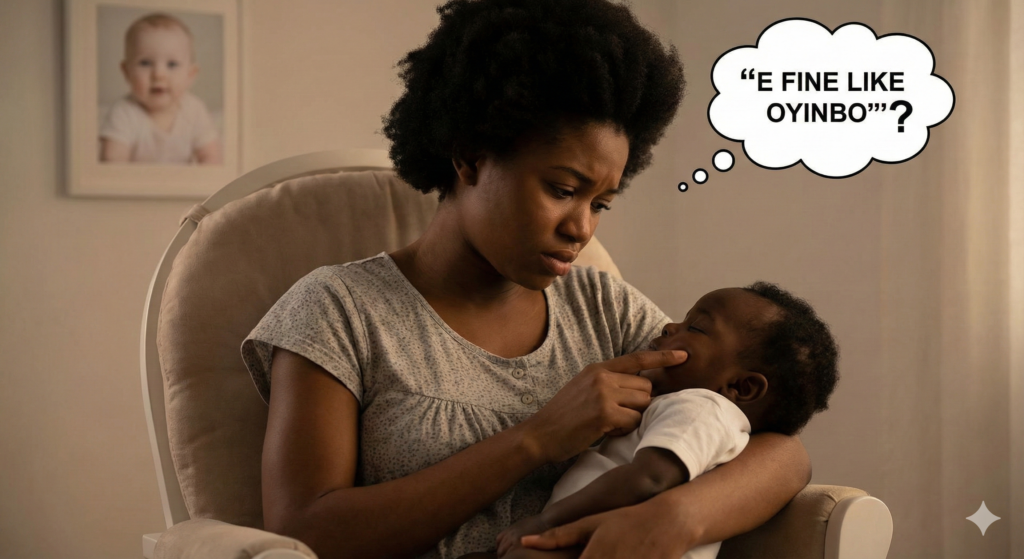
We were looking at a gorgeous, fully Nigerian child, born to two Nigerian parents, and declaring that the highest tier of beauty this child could achieve was to resemble a white person.
This observation led me down a rabbit hole of thought. As someone recently pointed out to me, it is an objectively strange benchmark. If we are being honest, physical attractiveness varies wildly across every race. There are stunning white people, and there are very average-looking white people. Whiteness itself is not a guarantee of beauty.
Yet, in the Nigerian subconsciously, “Oyinbo” has ceased to be just a descriptor of race. It has evolved into a synonym for “perfect,” “unblemished,” or “premium quality.”
Why do we do this?
I think it starts with what I call “melanin anxiety.” Many African babies are born lighter than their eventual skin tone, and their hair texture hasn’t fully coiled yet. When relatives celebrate the “Oyinbo” look, they are often subconsciously celebrating the temporary absence of pronounced African features.
There is often a subtle, unspoken undercurrent of relief. How many times have we heard the follow-up comment, “I just hope he won’t go and black o” as he gets older? It reveals a deep-seated fear of dark skin, viewing it as something that diminishes beauty rather than defines it.
Furthermore, in our society, lightness is too often correlated with “freshness” and wealth. Dark skin is subconsciously associated with the harsh Nigerian sun, suffering, and hard labor. Whiteness, or proximity to it, is associated with air conditioning, ease, and a “soft life.” When we say a baby looks “Oyinbo,” we are projecting a class fantasy onto them. We are saying they look expensive.
We also cannot ignore the religious hangover. For generations, the imagery of purity, angels, and holiness presented to us was overwhelmingly white. Conversely, darkness was coded as evil or demonic. When a new life enters the world, pure and innocent, our collective programming defaults to the imagery of “goodness” we were taught, which is white.
The great irony is that we use a lie to compliment our own truth. Nigeria has millions of breathtakingly beautiful, dark-skinned babies with tight, glorious coils. They are objectively gorgeous without needing a foreign comparison.
By saying a Nigerian baby is beautiful specifically because they “look Oyinbo,” we are teaching that child their beauty is valid only to the extent that it mimics a foreigner. It is the earliest, most insidious introduction to an inferiority complex, delivered with a smile in a maternity ward.
We need to find new ways to praise our children. We need language that celebrates the richness of their skin and the texture of their hair without needing a white benchmark to validate it. Our babies are not beautiful because they look like Oyinbos. They are beautiful because they look like us.

Leave a Reply